Rishikesh has always been a town that people photograph before they even unpack. Now there is a fresh reason to keep the camera charged. Bajrang Setu, the town's new glass-decked bridge across the Ganga, has shifted where visitors stand, when they arrive, and what they carry home. For anyone comparing hotels in Tapovan Rishikesh or shortlisting the best hotel in Rishikesh for a river-facing stay, this change matters more than it might first appear. Tiaraa Hotels and Resorts sits close enough to the action that guests can plan around the light rather than the traffic, which is exactly why travellers searching for best view hotels in Rishikesh keep circling back to it.
What Actually Changed
The old Lakshman Jhula was the default frame for decades. Narrow, swaying, crowded with two-wheelers and cows, it gave photographs a certain chaos that people loved. When it closed to the public on safety grounds, the town lost its most recognisable vantage point overnight.
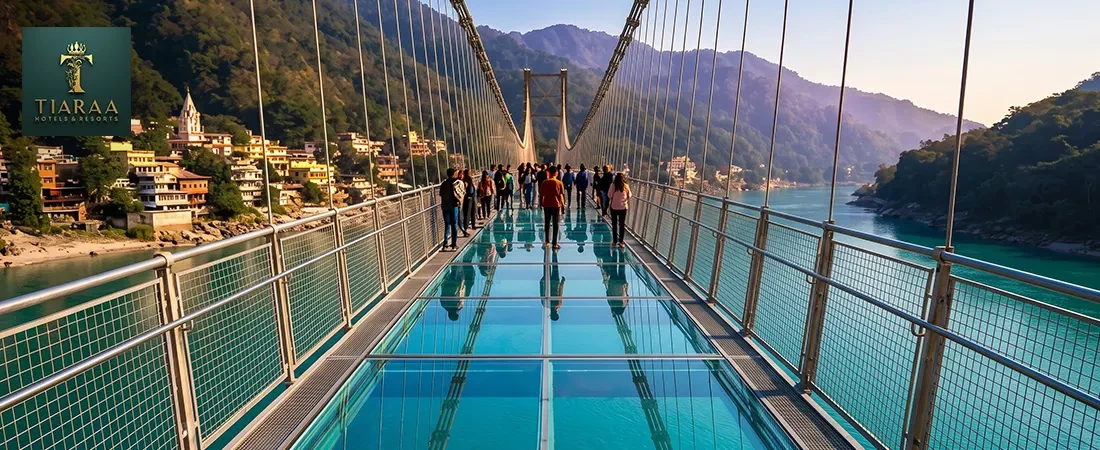
Bajrang Setu replaced it with something the Ganga had never seen here before: a walking bridge with a transparent central deck, wide enough for crowds, and engineered for the long haul.
Here is what shifted almost immediately:
- The vertical shot came back. The glass panels let people photograph straight down into moving water, a frame that simply did not exist in Rishikesh before.
- Crowd flow reversed. Foot traffic that once bottlenecked at Ram Jhula now spreads across two crossings, which means less waiting and cleaner backgrounds.
- Golden hour moved. The new alignment catches late afternoon light differently, pushing the best window roughly forty minutes later than photographers were used to.
- Tapovan gained ground. The bridge's eastern approach put Tapovan's cafés, ghats and hotels back on the walking route.
Why Photographers Are Rethinking Their Routes
Ask anyone who shoots Rishikesh regularly and they will tell you the same thing: the town used to be a two-stop assignment. Triveni Ghat at dawn, Lakshman Jhula at dusk, done.
That map is now outdated.
The glass deck introduces something photographers call a foreground problem, in the best possible sense. You are no longer shooting the river from beside it. You are shooting through the surface you are standing on, with the current visibly moving under your feet. It changes the emotional weight of the image.
A few practical observations from people who have already worked the bridge:
- Reflections are the enemy. A polarising filter or simply cupping your phone lens against the glass solves most of it.
- Early morning beats evening for clarity. Mist sits low on the water until about 7:30 AM and adds depth that afternoon light flattens.
- The approach ramps are underrated. The strongest wide shots are taken from the ramps, not the centre span.
- Weekdays are worth planning. Weekend footfall makes long exposures nearly impossible.
The Ripple Effect on Where People Stay
This is the part most travel write-ups miss. A new landmark does not just change photographs. It changes accommodation logic.
Before Bajrang Setu, staying in Tapovan meant a longer walk to the main crossings. Guests planned around that distance. Now the walk is shorter, safer and considerably more scenic, which has quietly made Tapovan one of the more sensible bases in town.
The knock-on effects are worth noting:
- Sunrise access no longer requires a taxi booked the night before.
- Riverside cafés in Tapovan now see genuine morning traffic rather than late brunch crowds.
- Hotels with elevated river views have become the practical choice rather than the indulgent one.
- Evening returns feel safer, since the new bridge is properly lit and monitored.
Travellers who once treated location as a secondary filter are now leading with it.
Planning Your Visit Around the Bridge
If you are building an itinerary, treat Bajrang Setu as an anchor rather than a stop.
Morning block: Cross at first light, shoot the mist, then walk into Tapovan for breakfast. The ghats below the eastern approach are quiet until about nine.
Midday block: Skip the bridge entirely. Harsh overhead light kills the glass effect and the crowds peak. Use this window for Beatles Ashram or a rafting slot.
Evening block: Return around ninety minutes before sunset. Position on the western ramp for silhouettes, then move centre for the last twenty minutes when the water turns copper.
Night block: Underrated and almost empty. The deck lighting creates a corridor effect that works beautifully for long exposures if you have a small tripod.
A Thought Worth Carrying
"The river is everywhere at once, at the source and at the mouth, at the waterfall, at the ferry, at the current, in the ocean and in the mountains, everywhere, and that the present only exists for it, not the shadow of the past, nor the shadow of the future."
Source: Hermann Hesse, Siddhartha, 1922
Hesse wrote this about a ferryman on an Indian river, and it lands squarely on what Bajrang Setu offers. Standing on glass above moving water, you are not looking at a view. You are standing inside a present moment that keeps arriving.
Frequently Asked Questions
- Is Bajrang Setu safe for children and elderly visitors?
Yes. The bridge was engineered with reinforced glass panels, continuous railings and a non-slip walking surface. Many hotels in Tapovan Rishikesh now recommend it as a comfortable family walk rather than an adventure activity requiring physical preparation.
- What is the best time of day to photograph the glass deck?
Between 6:00 AM and 7:30 AM offers mist, soft light and minimal crowds. Guests at best view hotels in Rishikesh often catch this window on foot, avoiding transport delays that ruin the narrow golden hour entirely.
- Are tripods and professional cameras permitted on the bridge?
Handheld equipment is generally allowed. Tripods are permitted during off-peak hours but discouraged at weekends when footfall is heavy. Checking with your hotel concierge before heading out saves an unnecessary walk and disappointment.
- How far is Bajrang Setu from Tapovan accommodations?
Most Tapovan properties sit within a fifteen to twenty minute walk. Choosing the best hotel in Rishikesh by proximity now genuinely affects how many sunrise sessions you manage during a short two night stay.
- Does the bridge get closed during the monsoon season?
Access can be restricted during heavy rainfall or high water levels. Restrictions are typically short. Confirming conditions with Tiaraa Hotels and Resorts or your chosen property before travelling avoids wasted mornings and last minute itinerary changes.
Closing Thoughts
Bajrang Setu did not just give Rishikesh another crossing. It redrew the town's photographic geography and, in doing so, quietly redrew its accommodation map too. The places that once felt slightly removed now sit at the centre of everything worth waking up early for. Tiaraa Hotels and Resorts understands this shift, which is why guests searching for the best hotel in Rishikesh or comparing best view hotels in Rishikesh find the pairing of elevation and access hard to argue with. Among hotels in Tapovan Rishikesh, the properties that let you step out at dawn and be on the glass within twenty minutes are the ones worth booking. Tiaraa Hotels and Resorts was built for exactly that kind of morning.